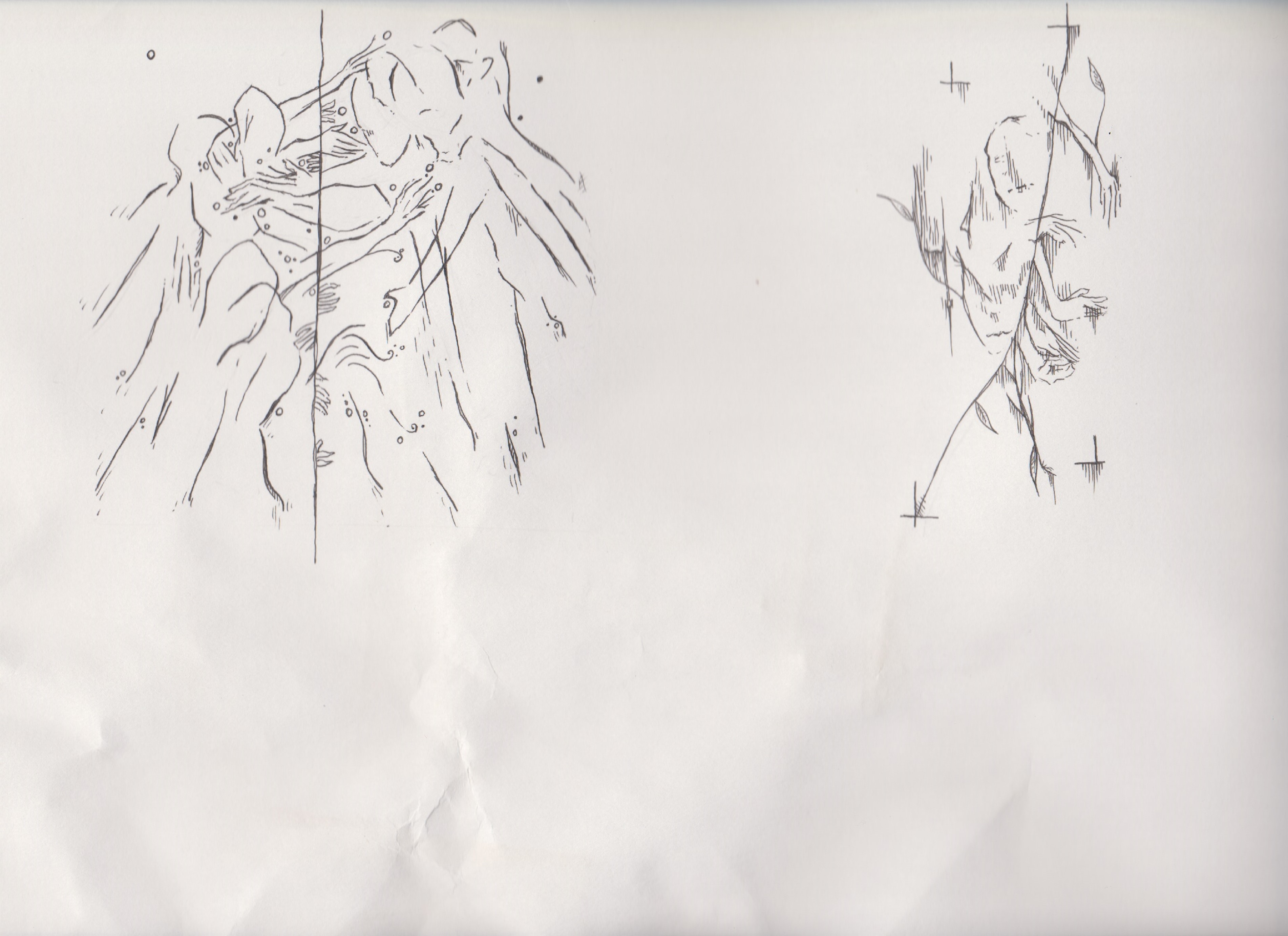
[...] refusing to not listen, even if she had a choice [...]
[csm STATEMENT DATED SPRING 2024.] An Elegy is by association expected to be an Elegy for some-one or some-thing. This Elegy is one for several, including but not limited to: Quentin Hubbard [son of L. Ron], Henry Borynski, Vivien Eliot, William McKinley, Seamus Heaney, Padraig Pearse, the Nintendo 64, pre-2019 socialism, Charles M. ‘Chuck’Jones, Maurice Scully, James Parrott, Charley Chase, Christopher Okigbo, the numbered and unnumbered of the Plague Years, Zbigniew Herbert, Thomas Sankara, Democracy in India, Scott Walker, politically-guilt-free soda-pop consumption, Bette Davis, Robert Lax, Emily Dickinson, the cowboy myth, permafrost, the Universal Declaration of Human Rights, the Green New Deal, Gloria Grahame, YouTube ads both advertising and created-by Artificial Intelligence that in-practice resemble little more than a modern variant of Walter Benjamin’s Mechanical Turk with the mirrors merely betterangled and the operator shrunken further from our view, Mel Blanc, Derek Jarman, Samuel Menashe, Veda bread when overseas, Rodney Koeneke, the poet’s grandfather William George Taylor, stable expression and with it the possibility of making sense, springtails.
[SYNOPSIS.] Events assume a course.██████████████████████████████████████████████ At times, events occur before they have occurred. █████████████████ snow ████████ snow ██████ stones ████.
The full list of samples is available HERE.
"Frescoes of the skull; that ‘trepanatory impulse’. ‘Dim consciousness first alone’ (Beckett, ‘Ceiling’); ‘the ceiling changed colour’. What’s the name of the game?; ‘The name isthe game’. ‘Poetry is a destructive force’ (Wallace Stevens); ‘there are here no rescuers’. Marsyas flayed; ‘a/n ear being skinned’. ‘Songs are like tattoos’ (Joni Mitchell); ‘blueblueblueblueblue’. ‘to stand in the shadow of the /wound’s mark in the air’ (Paul Celan); ‘shadow falls from man’. ‘Terrible things for a man with my condition’ (Beckett, Krapp’s Last Tape); ‘consuming two bananas in bed’. ‘the cult of the listener’?; I hear you listen. ‘Milk happens to itself’; ‘I may be hungry but I sure ain’t weird’ (Captain Beefheart, Safe as Milk)."
— David Wheatley, author of Child Ballad.
"Charlie McIlwain’s Elegy is a thought-provoking reflection on memory, loss, and (absent) confession. Repeated breaks in sense and syntax mirror the inability of
memory to capture charged events with clarity. McIlwain looks back on that which evades representation and offers us his reflections “in chalk”. To speak in chalk also implies the production of word and sound particles that remain on the sleeves, in the air, taken into the lungs. After reading McIlwain’s Elegy, you will carry some of its lingering chalk dust away with you.”
— William Keohane, author of Son.
"Charlie McIlwain is a contemporary shaman battling forces of light and dark on an extended KWEHR-tee keyboard, a poet’s poet, a cowboy with a Mac here to give the mind, body and soul what they long for, an artist who doesn’t come around often and isn’t born easily. Their work requests a subjective reading experience, in the way one might expect to read an abstract painting, feel a Miles Davis performance or discern images within the flames of a fire — the reader has to do some of the lifting to gather the wood here, but becomes all the warmer for their participation. E[MIT] is a happening, an event in aid of itself, where understanding isn’t as important as experiencing. McIlwain’s world is vital, various, a delicately plural symphony of signs, ritualistically bodying forth a tear in our expectation of language and poetic utterance while giving rise to how these are witnessed, here and now, collaborating anew."
— Jake Hawkey, author of But & Though.
"This is a fucking great set of surreal, whipsmart k-hole cantos delivered with register switch ups that surprised at every turn. [...] We had ‘white fire violetted daddy’, we had ‘sleep is just cloth’, ‘you can use your ass like an appliance’, we had literally two pairs of glasses, ‘stop killing Lorca’, imploring ‘the language is in trouble’ folded into ponderings borrowed from W.S. Graham, we had ‘Hegel ate a crow’, ‘the furniture will not endure perception’, we had Brian Wilson and John Clare ‘and shall I know that sleep again’. [...] like trying to trip talk with someone who is not tripping [...] I let myself (what comprises brain matter of synapse and syntax) be scrambled by signifying mayhem and enjoyed every minute. Go buy Charlie’s Elegy [Model Interaction Trend] now you fools! [...] When I found the remnants of some kind of pop-up carnival show on Kelvin Way, cycling home, dis-articulated along the road in luminous obstacle, I knew I was still riding through Charlie’s poem."
— Maria Sledmere, author of The Indigo Hours .
"Elegy reminded me and continues to remind me of Samuel Beckett’s work, particularly his short plays. [...] The wonder of these plays is how these very intimate and interior experiences are communicated on stage, moving between the embodied and the disembodied to give something. But it must be said, Beckett had the benefit of a stage, of an actor to do this. Elegy [Model Interaction Trend] is strictly on the page, but boy does it test the page. It works with and against itself, and quickly, the reader is lulled into a narrative readily with linguistic evaluations of ‘a stable image’, of ‘a sense’, of capital-t truth, together with lines like ‘someone will explain this… this pledging your love. The blue jay is a blue jay. Fragile in her nest’ and ‘it is a process of stitching.’ The experience becomes a more-than-mental experience. It’s one of those texts where, as a writer, you’re frustrated because you wouldn’t know how to begin composing something like this and its sheer invention. As a reader, it is utterly compelling in that you have the utmost trust in this writer and what they are doing – and so, you trust the piece. Elegy [Model Interaction Trend] is courageous, inventive and ambitious. It is lyrically seeking. It is embodying and disembodying. It is withholding but also open-hearted (or, to borrow a phrase from the pamphlet, ‘open-hatted’). Ultimately, it is as immediate as a text can get. There is so much I could say about this pamphlet, but I don’t think any combination of words could do it justice."
— Stephen de Búrca, author of Atlantic Fret, from his live introduction.
"destroyed classical leaning into frustrated mathematics."
—leaf missing.